Xuehuai He

/ɕye'hwaɪ/, any pronouns
- PhD student at Yale Linguistics (2025 – 2031.5)
- I am on personal leave and will not have access to the US or Yale from Sept. 2026. All plans to attend events / conferences in the US are cancelled.
- Previously undergraduate at Pomona College (2021 – 2025), majors in mathematics and linguistics.
Email: xuehuai [dot] he [at] yale [dot] edu
Last updated on Oct. 05, 2026.
Academic interests
- Syntax: voice, case, and person; argument structures; Uralic languages; differential object marking
- Semantics: numerals; the mathematical structure of plurals and partitives
- Others: programming languages theory; geometry, topology, algebra, and related math topics
Recent updates
- [202611] Planning on giving a talk on Finnish impersonals at ÖLT2026 in Salzburg, Austria. You can view the preliminary handout here.
- [202605] Attended WCCFL44 in Mexico City and presented an updated version of my BA thesis in Linguistics on Approximating Number Pairs in Mandarin Chinese. You can view my poster here and abstract here.
- [202508] Joining Yale Linguistics for my PhD studies.
- [202507] Attended ESSLLI 2025 at Ruhr-Universität Bochum.
- [202505] Attended the WAM 2025 workshop at the Institute of Advanced Studies, School of Mathematics, in Princeton, NJ. The theme of the year was Convexity and Combinatorics in Algebraic Geometry.
- [202504] Submitted my BA thesis in mathematics on the topic of polytopes. You can watch my presentation here!
Manuscripts
Approximation on Numerals: Insights from the Grammar of Approximating Number Pairs (ANPs) in Mandarin Chinese
Xuehuai He
- In the Proceedings of the 36th North American Conference on Chinese Linguistics, the Ohio State University & Pomona College, 2024.
- Abstract: Approximating number pairs (ANPs), like in ‘twenty or thirty people’, appear cross-linguistically and usually indicate an approximate range rather than a precise disjunction of either twenty or thirty. This paper explores the syntax and semantics of well-formed ANPs in Mandarin Chinese, proposing generalizations in semantic types and scopes of approximation across various approximative numeral expressions in Mandarin Chinese. I propose that approximative expressions on numerals are independent of the specific numerals chosen and the only variable parameter in the construction would be the range specific to the concrete approximative expression used.
- [PDF for current version]
Talks and posters
2026
Finnish impersonal passives are neither passive nor impersonal
Xuehuai HeÖLT2026 #talk
ÖLT2026 #talkIn this talk, I argue that the Finnish -ta/-tä/-ti verbal morphology, traditionally called the “impersonal passive”, is neither inherently passive nor impersonal, but instead realizes an active Voice head that selects either a null impersonal pronoun (nip) or a referential first-person plural subject. Crucially, the same morphology can induce an active, first-person plural reading when combined with the over 1-pl pronoun, showing that the verbal morphology itself does not encode impersonality. Based on evidence from unaccusative verbs, binding, control, case assignment under negation, and morpheme ordering, I argue that these constructions are syntactically active and that the morphology is generated in Voice. Finally, I propose that the Finnish null impersonal pronoun is a silent, ϕ-featureless bare noun whose interaction with this Voice head gives rise to the impersonal interpretation, situating Finnish within a broader typology of impersonal pronouns while accounting for its distinctive syntactic behavior.
You can view the current version of my handout here and 2-page abstract here.
2025
Unfolding Search Synthesis
Lucas Bang, Xuehuai He, Eli Pregerson, Jimmy Chen, Emma GandonouHaskell 2025 #talk
Haskell 2025 #talkAdaptive search (posing queries, observing outcomes, and refining knowledge) is a common pattern in security testing, logical deduction, and preference learning, yet typical implementations are ad-hoc and problem-specific. This talk presents a Haskell framework that expresses adaptive search purely as a recursion scheme, showing how the familiar trio of anamorphism, catamorphism, and their composition as a hylomorphism can express a generic solution to a wide range of adaptive search problems.
Starting from an imperative specification of how queries interact with an unknown target, written in a DSL, we perform symbolic execution to derive logical constraints on search parameters, perform model counting to compute probabilities of search outcomes, and generate search steps by maximizing expected Shannon information gain.
The resulting adaptive strategy is an online hylomorphism: an anamorphism lazily unfolds an optimal search tree while a catamorphism simultaneously drives the concrete interaction with an instantiated search problem, so only the explored path is ever materialized.
We will describe our Haskell implementation for adaptive search synthesis making use of functor algebras, and a few combinators, composed with model counting and information theory, unifying a wide range of problems.
Because we separates strategy synthesis (tree construction) from strategy execution, alternatives for critical components (model counters or information optimization algorithms) can be swapped in and out.
The talk will emphasize lessons for the broader Haskell community: - how recursion-scheme abstractions give a reusable template for search and inference, - how laziness enables demand-driven synthesis, and - how symbolic execution can be expressed functionally.
The work is ongoing: we are experimenting with larger search problem spaces and improved model counting. But the key ideas and approach are ready to share. We hope attendees will leave with a compact, idiomatic pattern for recognizing when a problem can be framed as an adaptive search and easily solved.
- Contact me for more details about this paper.
2024
The Grammar of Approximating Number Pairs in Mandarin ChineseXuehuai He
Presented at:
2023
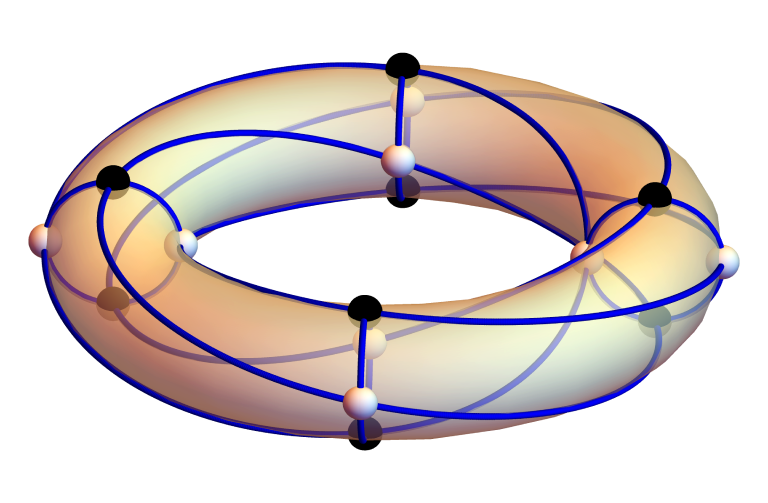
Adinkras as Origami
 Arsh Chhabra, Xuehuai He, Elena O'Grady, Melinda Yang, Cameron Thomas, Edray Goins
MathFest2023 #poster
MathFest2023 #posterAbstract: Around 20 years ago, physicists Michael Faux and Jim Gates invented Adinkras as a way to better understand Supersymmetry. These are bipartite graphs whose vertices represent bosons and fermions, and whose edges represent operators which relate the particles. Recently, Doran et al. determined that Adinkras are a type of Dessin d'Enfant by explicitly exhibiting a Belyi map as a composition $\beta: S \to \mathbb P^1(\mathbb C) \to \mathbb P^1(\mathbb C)$. We are interested in exhibiting the same Belyi map as a different composition $\beta: S \to E(\mathbb C) \to \mathbb P^1(\mathbb C)$.
- Presented at MAA MathFest in Tampa, Florida, USA in August 2023.
- [PDF for poster]